We’ve pushed the planet too far, so we have to act more sustainably. Customers and stakeholders expect it, and EU law now requires it: the Corporate Sustainability Reporting Directive (CSRD) and its European Sustainability Reporting Standards (ESRS) set the formal reporting rules. The EU also moved to regulate environmental claims with a proposed Green Claims Directive; Parliament set its position in March 2024, but the Commission withdrew the proposal in June 2025, so the next steps are unclear.

Starting in 2024, new reporting requirements ask organizations to analyze and assess ESG (environmental, social, and governance) topics and to document their progress. For most organizations, that triggers significant transformation before any report is filed. We therefore treat sustainability communication primarily as the communication that accompanies this change. The path to a more sustainable organization runs through internal shifts, which is why it’s essential to distinguish between mandatory external disclosures, voluntary external communication, and internal sustainability communication.
Sustainability communications cover how an organization communicates internally and externally about its ESG priorities, actions, and results across environmental, social, and governance dimensions.
Mandatory external sustainability communication focuses on CSRD compliance and formal reporting. Voluntary external sustainability communication belongs in the broader corporate and marketing communications mix. Internal communication is especially important at the outset to enable the shift toward a more sustainable company. Sustainable business often requires a fundamental, sometimes radical, change in mindset.
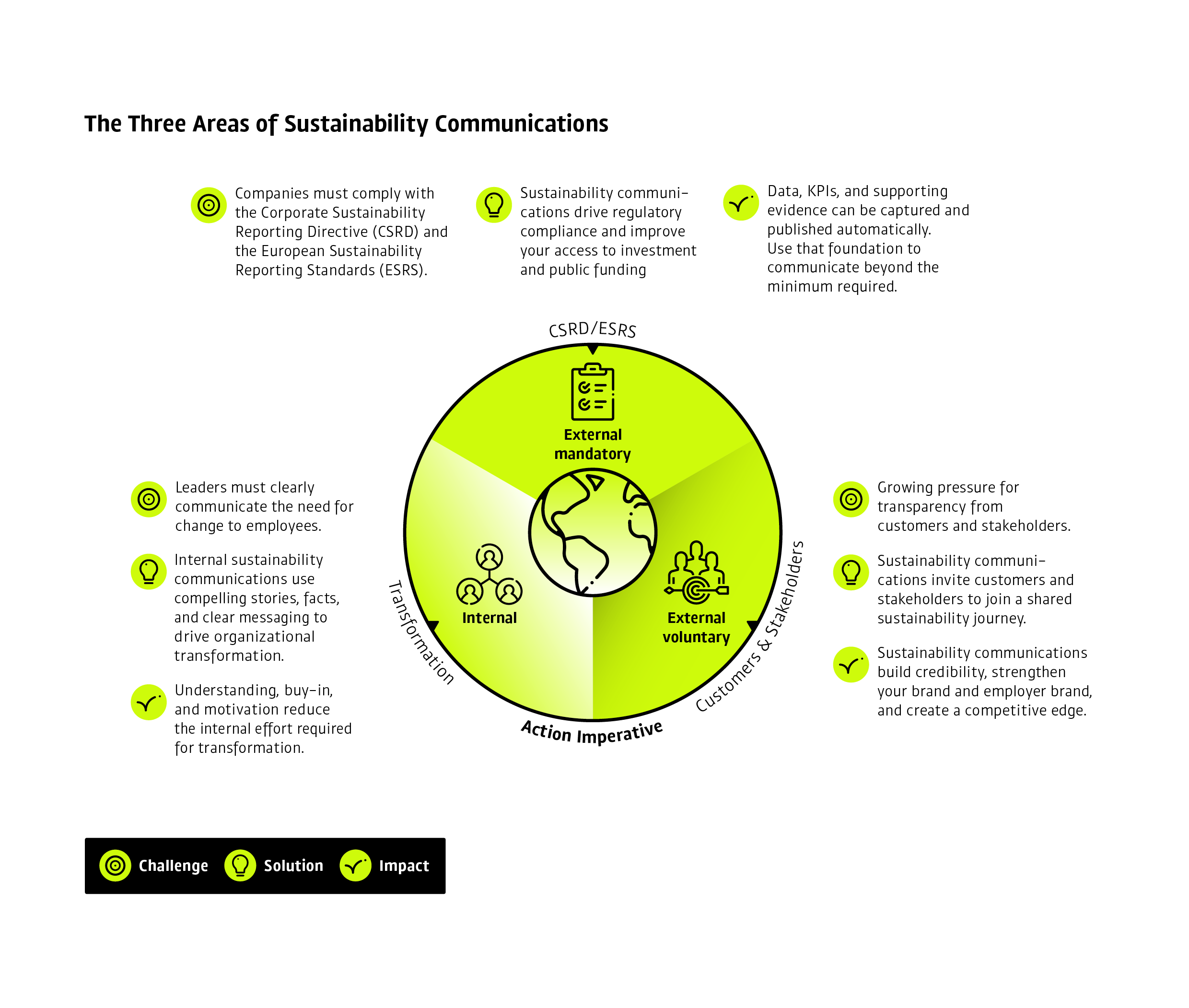
Bottom line: sustainability communications give companies and organizations a powerful lever for successful transformation. That strengthens the brand, including the employer brand, and builds lasting competitive advantage.
Download this summary as a PDF.
Photo: AdobeStock


